
By Kuba Dziedzicki, Guest Contributor
The data center buildout wave that the world is currently experiencing is driving economic activity, borrowing, and leading people to ask what is in it for them and their communities. As is the case with most controversial topics, there is a “YIMBY” (Yes in My Backyard) side and a “NIMBY” (Not in My Backyard) side. With the vast amount of resources required to build and maintain data centers (with prices expected to increase due to ever-increasing demand), it is only fair for people to search for their share of benefits from a technology that would not exist and have value without the existence of society. While the public will see some of the benefits of data centers and AI in terms of how it can make everyday tasks easier, provides various types of ideas, etc., the owners of the resources needed to create and maintain data centers stand to receive a great chunk of the benefits. A realistic question is why should the latter receive the majority of benefits when society provides so much underlying value for data centers and AI? And if federal lands are to be used to house data centers as has recently been suggested, the corporations that own these investments stand to gain even more. Let’s start the conversation by looking at what data centers are all about.
What are data centers used for?
Data centers (in one form or another) have been around since the 1940s, with the first one being built to house ENIAC (Electronic Numerical Integrator and Computer), a pioneering digital computer for the U.S. military [1]. Essentially all early computers lived in data centers where conditioned power, controlled environments, and even floor supports could be provided and machines operated and maintained. Fast forward to today and we have a global “edge” and “core” computing architecture. Edge computers include mobile phones, PCs, and smartwatches. Nearly all of these devices communicate back to centralized systems in data centers (or the cloud) which provide services such as websites, email, databases, phone calls, entertainment, and more. Without data centers, the internet would not function like it does today.
Why is there so much recent backlash against data centers?
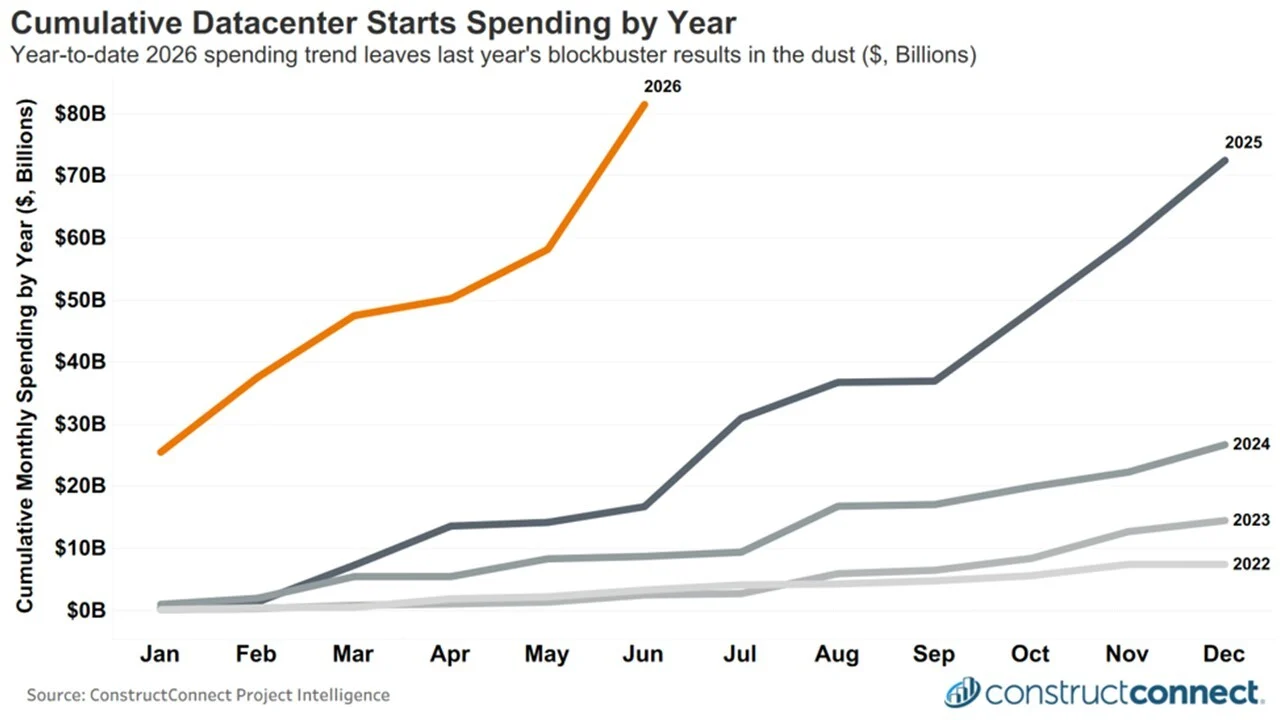
There has been a tremendous increase in public backlash over data centers over the last couple of years [2]. Figure 1 shows how much more money has already been spent on data center starts in 2026 compared to other years, even though 2026 is not yet over [3]. It appears that the main culprit is the increased usage of these facilities for operating AI, with AI expected to be up to 70% of this increased data center usage by 2030 [4]. Although data centers support a variety of technologies besides AI, AI workloads are expected to use 44 GW of power in 2026 (roughly equivalent to powering 35-37 million average U.S. homes for a year) while non-AI workloads are predicted to total 38 GW, with more data center capacity for all workloads expected to be added in the coming years [5].
AI is a technology that has only relatively recently been made accessible to the masses (think ChatGPT, Claude, Gemini, DeepSeek, etc.). Many individuals believe that the deployment and use of AI technologies is inevitable. Companies are creating/utilizing AI tools (such as chatbots) for purposes such as drive-throughs and automated phone systems, which sometimes leads to more frustration than satisfaction on the consumer end. Even companies that you wouldn’t expect to have a need for AI, such as shoe retailer Allbirds, adopt (some form of) it [6]. Errors are to be expected as this is an emerging technology. However, as AI usage continues (voluntarily or involuntarily), it can be expected that the accuracy/reliability of it will improve.
Some downsides of the rapid data center expansion (the data center industry is forecasted to nearly double in size between 2025 and 2030 [5]) include environmental impacts such as increased electrical power and water use and an increased reliance on imported materials. Global power demand by data centers is expected to reflect “a 16% compound annual growth rate from 2023 through 2028—up from the 12% rate over the years 2020 through 2023,” with data center power demand in the U.S. accounting “for up to 60% of total load growth from 2023 through 2030” [7]. For data centers to remain functioning, they need to be cooled. Large data centers can use up to 5 million gallons of water per day for this purpose [5]. Unfortunately, many data centers are found in areas where water is becoming scarce [8]. Put those two together and someone will be suffering from this prioritization of water usage. The data center expansion has also sharply increased “imports of processing equipment, computing hardware, and other related parts and machines” [9]. Figure 2 shows the imports of AI-related goods taking off in early 2024 [8]. With the associated costs of increased AI use, it’s no wonder that society is scratching its head and asking whether AI is actually worth developing.
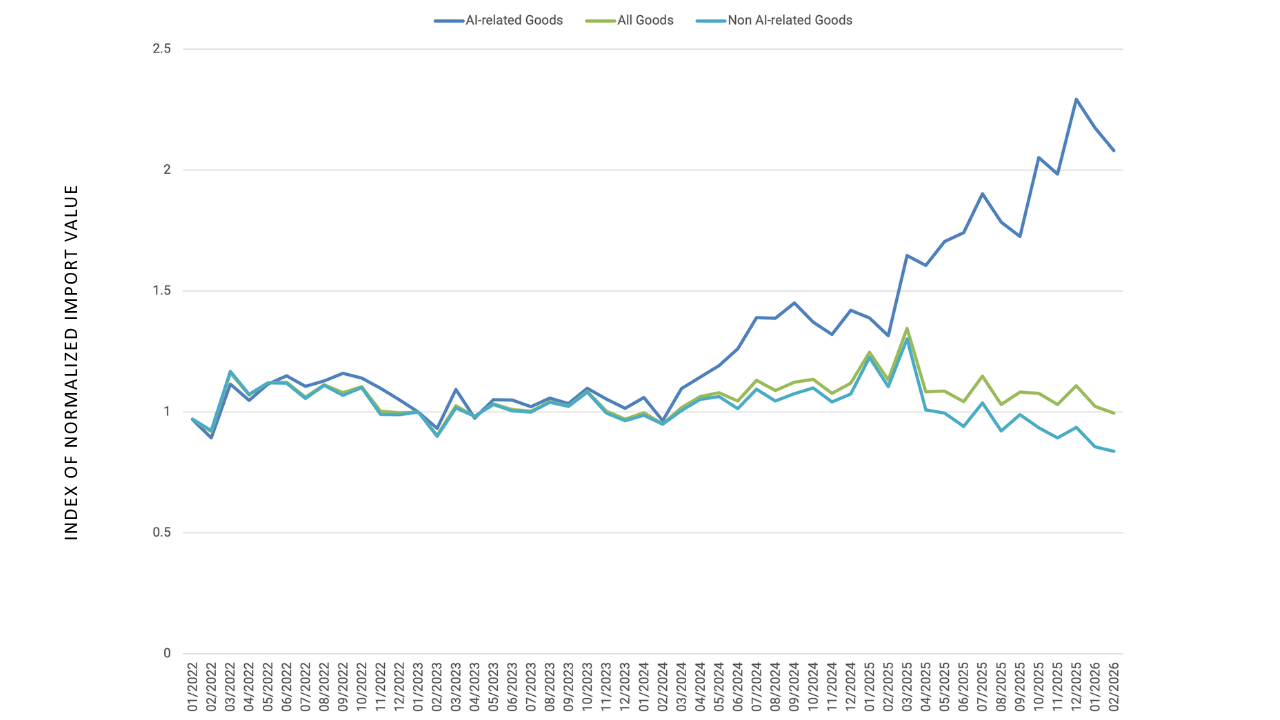
Source: Data is from Trade Data Monitor, LLC; AI-related goods categories are from Michael E. Waugh.
Despite these challenges, it is likely that over time society will get used to AI and grow more dependent on it, leading to the technology being assimilated into daily life. Due to this increase in AI use, data centers will continue to be necessary in years to come due to the capacity for vast services. Unless corporations were magically able to receive a refund for their massive investments in the data center buildout associated with AI, they will most likely follow through with their infrastructure plans.
Using a land value tax to mitigate the effects of data centers
These increases in AI deployment seem destined to continue despite the chorus of AI corporate leaders calling for a slowdown in AI development. Such cautions have been squelched by the U.S. administration which has vocally insisted that there is no need for such restraint [10]. Taken in net, it is clear that AI usage will contribute to further expansion of data centers for both AI and traditional computer workload. As a result, mitigating the negative effects of this development is warranted. Luckily, Henry George popularized a solution to do just this.
In Progress and Poverty, George stated that “the term land embraces, in short, all natural materials, forces, and opportunities” [11]. By taxing data centers through a land value tax (a tax which focuses only on the land below structures, not the actual buildings), not only the land on which the data centers are located would be taxed but also related resources. The water, electricity, and other natural resources used would also be taxed in the same way. The prices that companies pay for land alone to build their data centers justifies the introduction of a land value tax (LVT). For example, “a data center developer reportedly offered $4.4 million per acre for land” in Loudoun County, Virginia, where the land was only valued at “$125,000 per acre” based on 2025 data [2]. With this kind of return on land, it is clear how much value society is adding to data centers and AI.
In fairness, this approach adjusts the beneficiaries of this technological build-out to include both the investors and the society from which the resource value is originally derived. This value could be returned to society via a land value tax. Due to AI using the collective knowledge of society to provide its “service,” it makes sense to return the value that people add to AI back to society. A land value tax would eliminate rent-seeking (unearned profit, i.e. gaining profit from land speculation without adding any improvements) from the land and natural resources used for data centers. It could also be used to subsidize the increased costs of water and electricity to consumers and create programs that would soften the blow of lost land and jobs.
Using federal land to fast-track a federal land value tax
To scale this approach, a national view is recommended. Since the current U.S. administration has announced that it is repurposing federal land to host data centers (such as in Paducah, Kentucky on a retired uranium enrichment facility from the Cold War-era), the implementation of a federal land value tax may be feasible [12]. Starting as a “pilot tax” on data centers, the fast-track path for a federal land value tax could be explored. As a next step, many state constitutions limit what kind of taxes a municipality can implement. With a federal model law in place for LVT to support recouping data center social costs, traditional “grassroots” or “bottoms-up” methods of bringing about laws via local municipalities could be skipped. A revenue sharing agreement could be implemented between the federal government and state/local governments so that communities directly affected by data centers get their fair share of the collected land value tax. Instead of waiting years before any state legislation is passed to allow local land value taxes, a federal land value tax could come into effect much quicker. Using the data center wave as a catalyst, local jurisdictions might capture the land value effect that’s happening right now. Why wait to capture the gains? And the best part about a federal land value tax? It doesn’t discriminate where data centers are located. Regardless of what state they’re in or if they’re on federal land or not, the land they’re on would be taxed fairly.
Conclusion
Data centers have existed for almost a century. They make the internet what it is today. Without them, life would look completely different. With the boom of AI over recent years, more data centers are being built to accommodate the ever-increasing need for compute capacity. While data centers bring about plenty of negative effects, the buildout does not appear to be slowing down. With this being the case, and with data centers to be built on federal land, the idea of a federal land value tax becomes more feasible. This would bypass the slowdown that would be caused by the process it would take for local municipalities to implement a land value tax via state legislation. While the increased use of data centers (regardless of whether for AI use or not) will bring about negative effects, a land value tax would mitigate such impacts and return the value that society creates for data centers and AI.
References
- Enconnex, “The History of Data Centers: An Exponential Evolution”, Enconnex, March 22, 2024.
- Burns, Tobias, “AI data centers are transforming rural land markets — and fueling a backlash”, CNBC, September 6, 2026.
- Guckes, Michael, “August 2026 Data Center Report: Construction Starts Total $22.3 Billion, Second Highest on Record”, ConstructConnect, July 28, 2026.
- McKinsey Quarterly, “More data, more demand”, McKinsey & Company, viewed September 18, 2026.
- Programs, “Measuring the Data Center Boom: Facts and Statistics (2026)”, Programs, September 12, 2026.
- Murti, Lola, & Fonrouge, Gabrielle, “Struggling shoe retailer Allbirds makes bizarre pivot to AI, adds $127 million in value”, CNBC, April 15, 2026.
- Lee, Vivian, Seshadri, Pattabi, O’Niell, Clark, Choudhary, Archit, Holstege, Braden, & Deutscher, Stefan A., “Breaking Barriers to Data Center Growth”, BCG, January 20, 2025.
- Nicoletti, Leonardo, Ma, Michelle, & Bass, Dina, “AI Is Draining Water From Areas That Need It Most”, Bloomberg, May 8, 2025.
- Diamond, John W., “AI Investment Reshapes US Import Patterns”, Baker Institute for Public Policy, May 29, 2026.
- Breuninger, Kevin & Haddad, CJ, “Trump goes scorched earth on AI warnings, raging about data center opposition and regulation”, CNBC, September 14, 2026.
- George, Henry, Progress and Poverty: An Inquiry into the Cause of Industrial Depressions and of Increase of Want with Increase of Wealth. The Remedy., D. Appleton and Company, New York, 1879.
- Plumer, Brad, “Trump Administration Is Repurposing Federal Land for A.I. Data Centers”, The New York Times, July 29, 2026.
REPLIES