

Abstract
The memo below was crafted to explain the methods advocated by the UN NGO organization known as the International Union for the taxation of Land Value (IU) to the Executive Director of the Asset Leadership Network (ALN), Michael Bordenaro, so that a possible collaboration can be formed between the two groups. Each has at least one person who is actively engaged within the United Nations and each is accredited with the UN Economic and Social Council (ECOSOC). IU has reached out to the leader of the nation of Burkina Faso to congratulate him on his efforts to better serve the interests of his people, now that its colonial power has withdrawn. ALN has an associate who is actively working on a water supply project in Uganda. It is my hope that we can collaborate and unite our efforts and each serve both nations in some manner. The initial meeting of the two groups found some common ground.
Introduction
Political economy is an arcane subject to many people, but it’s my job to make it easy to understand as an instructor at the Henry George School of Social Science (HGSSS). I won’t bother to describe the dominant political economy of the United States, where private firms are focused on extracting wealth through production and financialization schemes while providing social programs as an afterthought, if at all. Alternatively, we are left with Marxist theory, Georgist theory, and some blending of programs where the purpose of government revolves around outcomes that promote opportunity for earning a good living, good health, and peace among nations, primarily through the provision of infrastructure assets and urban services. Marxists believe workers deserve an increasing share of a surplus when produced. Georgists say there’s plenty of surplus for the capitalist and labor, but nothing for the rentseeker (rentier). In economic terms, Marxist see the world as a battle between Labor and Capital, with little thought of complexity of social relations regarding the management of Land (lumping rentiers in with capitalists), and Georgists see joint interest between Labor and Capital, against the rentier who captures Land Values and other forms of economic rent. It is this economic rent that is the source of wealth that communities should share, and if private interests get the rent first there’s less of it to go around … and if the rent is not captured by communities and communities attempt to provide social service without it, the revenue for those efforts is typically extracted from people’s wages, home value, and purchases (sales taxes), making themselves worse off. It is the economic rent captured by the rentier that should be entirely given to the community, as a group itself or through an agency of government, or regulated non-profit organization, on behalf of said agency. In this paper, I explore two examples of how a Georgist strategy work, and identify adverse outcomes when other methods are followed. The remainder of the paper consists of a discussion of theory, a case for transit, case for water supply, conclusions, and lessons for use by a UN NGO.
Theory
Georgist philosophy begins with what is owed to each child brought into the world. All agree with access to air to breathe, most with access to water to drink, but less so with access to land for employment, creative enjoyment, and leisure. We believe in the absolute, and if access is restricted in some way, those with the power to restrict owe the community a fee, a tax, or a duty to prevent harm to air, water, and land as an obligation. In the case of land, Georgists are best known as advocates for taxing the unimproved value of land, while ending all taxes on labor, capital, homes, and other earned incomes. In this way, while the child can’t enter any property at will, they are provided an alternative funded through obligation. While air and water are regulated against pollutants, water is also naturally scarce in some regions, so special arrangements are made to satisfy competing demands. We all learned in Econ 101 that economics is all about managing scarce resources … but what if resources are artificially scarce so as to yield higher profits to the owner, as in monopoly control? In a thriving community, land values are never scarce, so economics may better be described as the providing the goods to people with the least amount of waste and least amount of undeserved privilege. In this memo, the case for land value taxation is straight forward, especially because it comes with a boost in take home pay, more money to buy goods, and no penalty for living in a comfortable house. In the case for water supply discussed below, the Georgist principle is somewhat obscure … I say anytime economic rent is kept to a minimum in the conduct of human affairs, George would smile … with the Ostrom principles for a common pool resource management system, the rentier is excluded by design, so there’s no need to tax away that which was inappropriately captured … a crucial step is taken, as the system has been practiced for thousands of years. My doctoral research confirms the system is working and experiencing increasing interest even in the politically conservative region around Tampa, Florida.
Transit Case
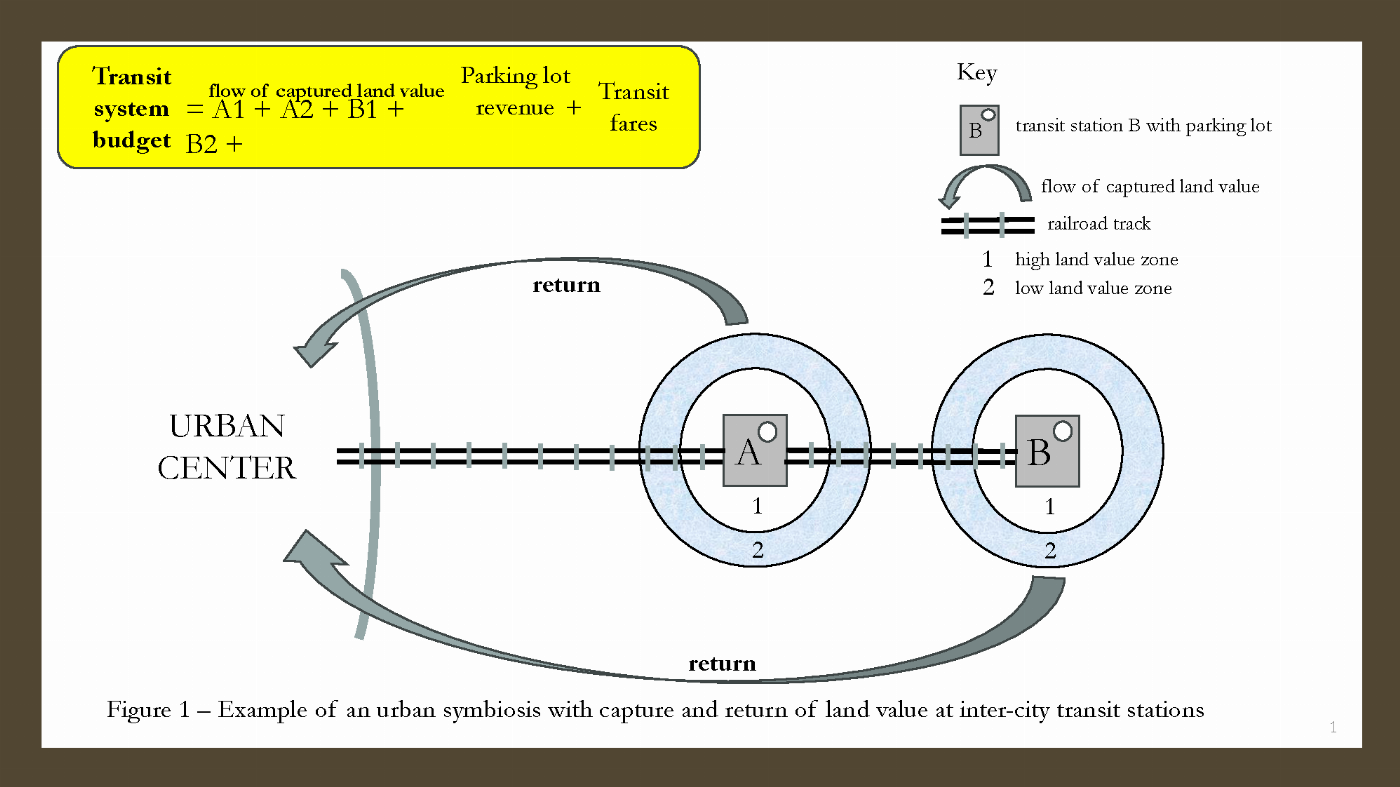
The first case refers to Figure 1, where a city (to the left) is the origin of a transit system, from the location where jobs and opportunities are plentiful. As transit operators in Hong Kong, Tokyo, and Singapore have found, riders may be able to ride for free or very low cost because the fare box is supplemented heavily by taxes on land values about suburban transit stops. In the case of the Long Island Rail Road (east of NYC), 126 stops could be taxed (higher) in this way to eliminate a subsidy paid to property owners at those stops paid by taxpayers in Buffalo and beyond. I believe most people would see this as a no brainer. If there isn’t sufficient land value there, affordable housing could be built at the stops, with the railroad owning the land and housing to solve multiple social needs. If the local community objects, the railroad could close the stop.
Water Supply Case
From my research on Tampa’s water management, early on (1990s) the manager turned Elinor Ostrom’s ideas about common pool management into a major shift from what the region was doing … every county had their own sources and they had a weak alliance that did not prepare for a growing demand. Common sense prevailed, and although nobody suspected a socialist-communal arrangement was being hatched, it was, and everybody embraced it (a few objected at first). I spoke with Jerry Maxwell, who organized the entire effort and he told me what the design was, and it was Ostrom’s common pool principles. See the reference here for those eight principles. A good way to describe them is … what does the collective own, where is it, how big is it, are there any free riders we don’t know about, how best can we form a system of pooled water where some is in storage reservoirs, some available with desalination during emergencies, what are the rules for sharing, the penalties for not following rules, and who will enforce. A professional, private firm manages the day-to-day operations of the authority, but all critical decisions are made by representatives of the collective. There is no private tollbooth collecting money as a privilege of ownership, as the water is commonly owned.
Adverse Outcomes
Here are two water supply disasters; Flint, Michigan and La Paz County, Arizona.
Flint – A state-imposed financial manager (Michigan) switched (2014) the city’s water supply from a safe source to a toxic one in order to save $5 million. Twelve thousand predominantly African American children under age 6 consumed dangerous levels of lead for 18 months, causing permanent brain damage. No jail time for the perpetrators. Neither was anyone jailed for conducting the 40-year (1932-1972) Tuskegee Syphilis Study on impoverished African American men. Although penicillin was found to cure syphilis in 1947, it was deliberately withheld (Joseph Mengele would be so proud) because the researchers wanted to observe the natural progression of the disease until their deaths. God bless America.
La Paz County – Loose water laws in western Arizona allows a Saudi Arabian company to withdraw (beginning in 2014) 15 billion gallons (and counting) of fossil groundwater (not being recharged) from state-owned land, while depleting what is available to longtime residents, all for growing alfalfa for export/profit. State only receives a nominal fee for a simple leasing agreement. Although attempts to stop the pumping have been made, the pumping continues, causing the water table to drop by 240 feet. Loss valued at $2.5 billion. This is pure economic rent.
Conclusions
It’s all about limiting economic rent. The elites of the world hate Georgists because we shine a bright light on the schemes that make them filthy rich. If the meek inherent anything, they best stop apologizing for being alive. Seize what’s yours. God gave it to you. And what you don’t have somebody probably has an obligation to give it to you.
Lessons for Use by a UN NGO
ALN and IU could take these cases and the theory behind them to Uganda and Burkina Faso to see if there is interest in new thinking.
Marty Rowland, PhD., P.E.
REPLIES